Healthcare systems today generate enormous amounts of data, from Electronic Health Records (EHRs) to clinical notes and diagnostic results. However, traditional hospital infrastructures often struggle with fragmented data, limited interoperability, and insufficient computational power to handle large-scale analytics [1].
This is where cloud computing becomes particularly relevant. By offering scalable storage and advanced processing capabilities, cloud platforms are reshaping how healthcare data is managed and analyzed.
One example of this transformation is Amazon Web Services (AWS) HealthLake, a cloud service designed specifically for storing, structuring, and analyzing health data at scale [2].
What is AWS HealthLake?
AWS HealthLake is a cloud-based healthcare data platform that organizes medical data using the FHIR standard and applies Machine Learning to extract clinical insights from unstructured text.
AWS HealthLake is built around the FHIR (Fast Healthcare Interoperability Resources) standard, which ensures that medical data can be shared and interpreted consistently across different healthcare systems [3]. This is especially important in environments where patient data is distributed across multiple providers.
HealthLake also includes built-in Machine Learning capabilities with tools that can automatically identify and extract key clinical information such as:
- Diagnosed medical conditions.
- Prescribed medications.
- Medical procedures.
- Relationships between patients and clinical events.
This ability to transform unstructured clinical notes into structured data is particularly valuable for biomedical research and healthcare analytics.
“Cloud computing is a model for enabling convenient, on-demand network access to a shared pool of configurable computing resources (e.g., networks, servers, storage applications and services) that can be rapidly provisioned and released with minimal management effort or service provider interaction.”
— National Institute of Standards and Technology (NIST) [1]
AWS HealthLake is used in a variety of biomedical applications, including [4]:
- Population-level health analytics.
- Clinical decision support systems.
- Predictive modeling for disease outcomes.
- Integration of heterogeneous medical records.
- Large-scale biomedical research studies.
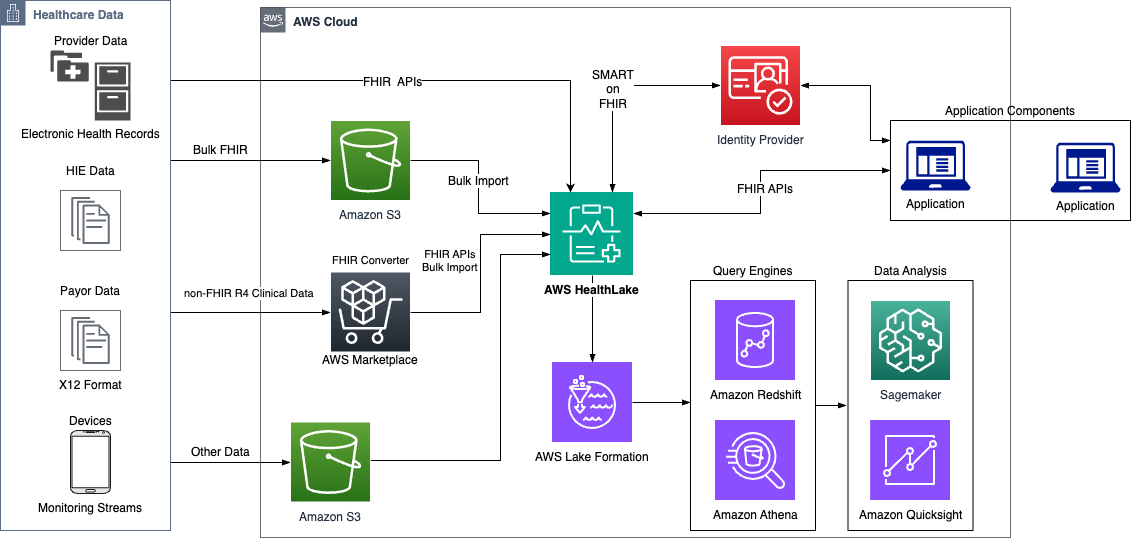
Figure 1: AWS HealthLake overview architecture [2].
Despite its advantages, cloud-based healthcare systems also introduce important challenges. Data privacy and security are the main concerns, particularly when dealing with sensitive patient information.
Healthcare cloud systems must comply with strict regulations such as GDPR and HIPAA, which indicate how medical data is stored, processed, and shared.
Other challenges include [4]:
- Integration with legacy hospital systems.
- Data migration and standardization complexity.
- Dependence on cloud providers.
- Ensuring interoperability across institutions.
Overall, AWS HealthLake shows how cloud computing is being used to support and advance biomedical data infrastructure. It enables more efficient analysis by combining standardized data formats with scalable cloud processing and Machine Learning. As healthcare data continues to grow, HealthLake will likely become increasingly more important to both clinical practice and biomedical research.
References
[1] Navale, V., & Bourne, P. E. (2018). Cloud computing applications for biomedical science: A perspective. PLoS Computational Biology, 14(6), e1006144. https://doi.org/10.1371/JOURNAL.PCBI.1006144
[2] FHIR Storage and Interoperable Health Data Standards - AWS HealthLake - Amazon Web Services. (n.d.). Retrieved April 22, 2026, from https://aws.amazon.com/healthlake/
[3] What is AWS HealthLake? - AWS HealthLake. (n.d.). Retrieved April 22, 2026, from https://docs.aws.amazon.com/healthlake/latest/devguide/what-is.html
[4] What is AWS HealthLake: Features, Benefits & Real Examples. (n.d.). Retrieved April 22, 2026, from https://www.peerbits.com/blog/aws-healthlake-explained-use-cases.html